On darkness, emotion, and the pieces we choose to live with
As an artist, I spend a tremendous amount of time thinking about why certain works of art stay with us. But collecting art has taught me something slightly different.
There is a difference between appreciating a work and wanting to live with it.
I can admire hundreds of paintings. I can recognize skill, composition, technique, originality, or beauty. But every once in a while, I encounter a piece that goes beyond admiration.
I want it near me.
I want to keep looking at it.
I want to understand it, even when I am not entirely sure that I can.
Those are usually the works I end up collecting.
Two pieces in my own collection are good examples of that.
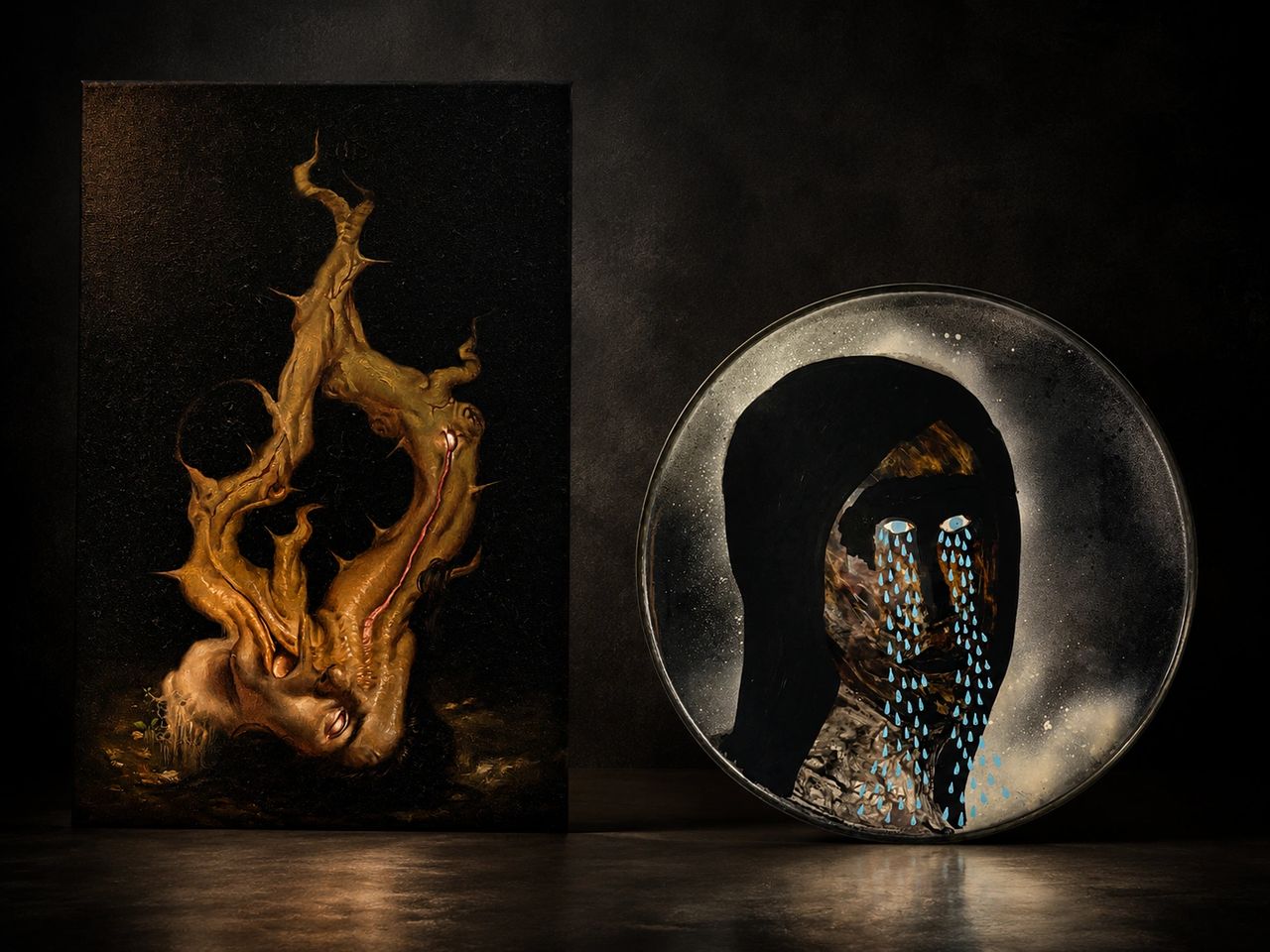
One is LA NASCITA DELL'ODIO by Italian painter Giovanni Grassi, an oil painting on canvas measuring 50 × 90 cm.
The title translates to The Birth of Hatred, and even before knowing the title, the painting has an immediate presence.
It is dark, strange, almost mythological. The figure feels as though it is transforming, growing, burning, or emerging from something. There is beauty in it, but there is also discomfort.
That tension is exactly what drew me to it.
I do not need a painting to make me feel comfortable.
In fact, some of the works I respond to most strongly do the opposite.
They make me curious.
They make me slightly uneasy.
They leave questions unanswered.
And they continue revealing themselves the longer I live with them.
Another piece in my collection is Tears for You, painted on a drum head by Mario Duplantier, drummer and artist from the French metal band Gojira.
It is completely different from Grassi's painting, yet I was drawn to it for many of the same reasons.
The face is almost mask-like. Tears fall dramatically from the eyes, and the entire image carries a sense of sadness, mystery, and theatrical emotion.
It is not quiet art.
It has personality.
And because it is painted on a drum head, the object itself carries another layer of meaning. It connects visual art, music, performance, and the artist's own identity in a way a traditional canvas might not.
That matters to me.
I Am Drawn to Art With a Story
When I look around at the artwork I have chosen to collect, I realize that I am rarely drawn to something simply because it is pretty.
Beauty certainly matters to me, but beauty can exist in strange places.
It can exist in melancholy.
It can exist in darkness.
It can exist in distortion, symbolism, mythology, fear, transformation, grief, and mystery.
Some of the artwork I love most contains a tension between beauty and something more unsettling underneath it.
Perhaps that comes from being an artist myself.
When you make art, you begin to recognize when another artist has put something genuine into a work.
Sometimes you can feel when a piece has been made because the artist needed to make it.
That energy is difficult to imitate.
Collecting Is Deeply Personal
I think people sometimes feel intimidated by the idea of collecting art.
They worry about whether something is important enough, valuable enough, famous enough, or the “right” thing to buy.
But I have never believed that is where a meaningful collection begins.
A collection becomes interesting when it reflects the person who built it.
You begin to notice patterns.
Certain colors.
Certain moods.
Certain subjects.
Certain emotions.
The things you are repeatedly drawn to begin telling your own story.
My collection certainly does.
There is often something symbolic, emotional, unusual, spiritual, mysterious, or slightly dark in the pieces that capture my attention.
I do not consciously set out looking for those things every time.
I simply seem to recognize them when I see them.
And I think that is part of what makes collecting so personal.
The Art That Stays With Us
As a gallery owner, I see a huge variety of artwork through NOMA.
Some pieces are immediately impressive.
Others become more interesting the longer you look.
And every so often, a work appears that simply stops you.
That is one of my favorite moments.
There is no formula for it.
It might be beautifully rendered or completely raw.
It might be subtle or dramatic.
It might be comforting or unsettling.
But it has presence.
That is something I pay attention to both as a collector and as someone viewing artwork for exhibitions.
I think memorable artwork gives us a reason to remain with it.
A question.
A feeling.
A story we cannot quite finish.
There Is Beauty in the Dark
Both of these pieces in my collection lean toward darker imagery, and I find that interesting because darkness in art is often misunderstood.
Dark art does not necessarily mean negative art.
Darkness can be mysterious.
It can be psychological.
It can explore grief, mythology, mortality, transformation, spirituality, fear, dreams, the unknown, and the parts of human experience we do not always speak about openly.
Some of the greatest artwork throughout history has lived in that territory.
Artists have always explored the boundary between beauty and fear, life and death, the sacred and the unsettling.
That space can be incredibly fertile.
It is also one of the reasons I am especially excited about NOMA's upcoming DARK II: Beyond the Veil artist call.
I am interested in seeing what artists do when they are given permission to explore beyond the comfortable and familiar.
Not darkness simply for shock value.
But darkness with meaning.
Atmosphere.
Symbolism.
Emotion.
Mystery.
The unknown.
Buy the Work You Keep Thinking About
If I could offer one piece of advice to someone beginning an art collection, it would be very simple:
Pay attention to the artwork you cannot stop thinking about.
Not the piece you think you are supposed to like.
Not necessarily the piece that matches your couch.
Not the work someone tells you will increase in value.
The one you keep returning to.
The one that makes you curious.
The one you remember after you leave.
Because those are usually the works that become more meaningful with time.
The best pieces in a collection do more than decorate a room.
They become part of your environment.
Part of your memories.
Part of your story.
And sometimes the art we choose to live with tells us something about ourselves before we even realize it.
Thank you for reading and I am looking forward to your Dark II submissions,
Mel Fiorentino