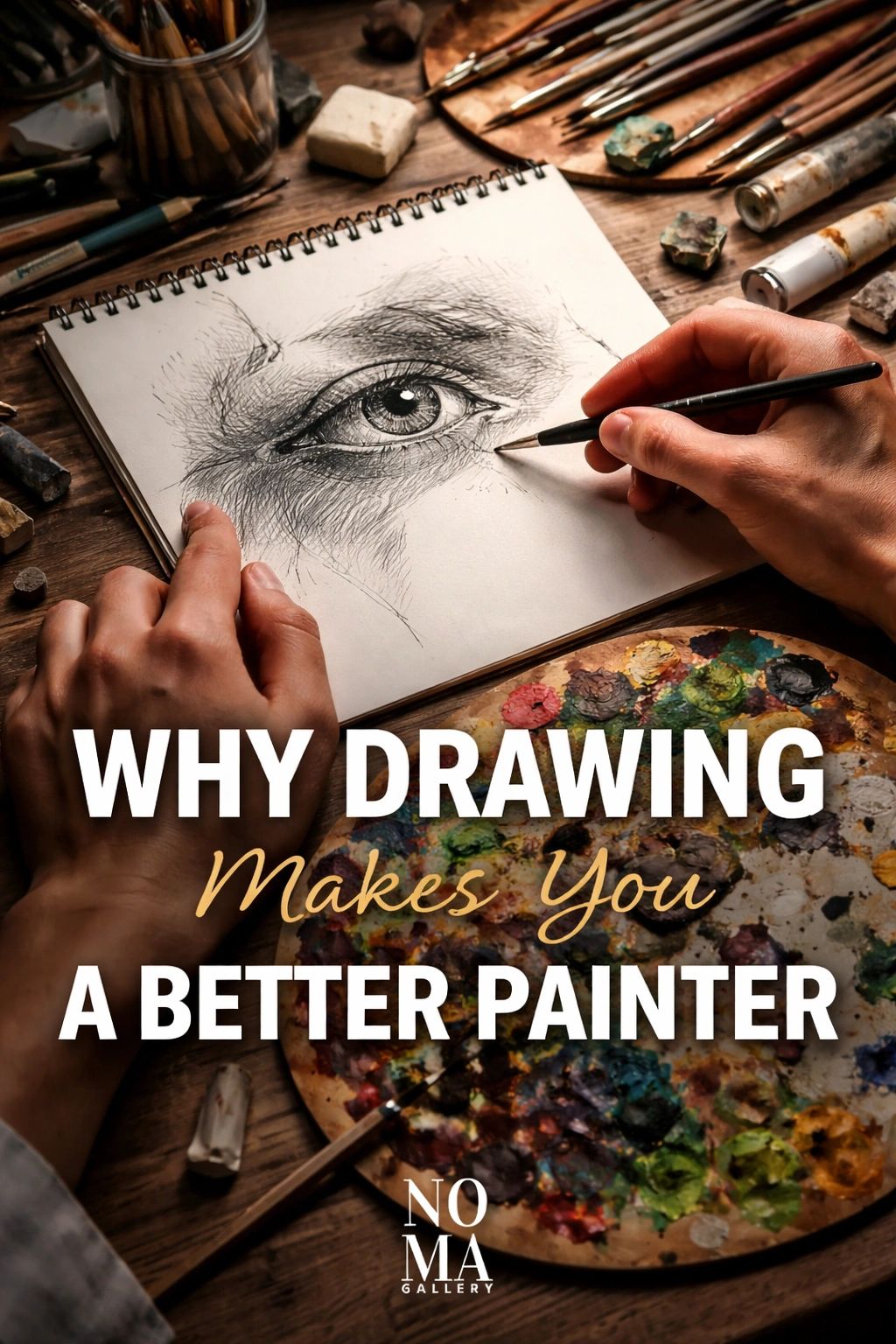
If painting is the performance, drawing is the rehearsal—every single time you pick up a pencil, you’re training the exact skills that make your brushwork smarter, cleaner, and more confident.
A lot of artists think drawing is only about “getting proportions right.” It’s not. Drawing is where you build control: control of your hand, your eye, your pressure, your edges, your values, and your decision-making. And that control transfers directly into painting.
Drawing Is Brush Control in Disguise
When you draw, you’re constantly adjusting pressure—light, medium, heavy—often within the same line.
That is the same muscle you use in painting:
- light pressure = soft edges, veils, scumbles, delicate transitions
- firm pressure = decisive shapes, sharper edges, stronger accents
- controlled pressure changes = beautiful variation, rhythm, and clarity
If you can’t control your pencil pressure, you’ll usually struggle with:
- heavy-handed paint application
- “muddying” passages by overworking
- outlines that won’t soften
- brush marks that look accidental instead of intentional
Drawing trains your hand to obey your intention. That’s the whole game.
Drawing Teaches You to See Like a Painter
Before you can paint well, you have to see well. Drawing builds:
- value awareness (what’s truly light, mid, or dark)
- edge awareness (where it’s sharp vs. where it disappears)
- shape design (big simple shapes first, details last)
- proportion + angles (the foundation of believability)
A strong drawing doesn’t just make the painting easier—it makes the painting possible. When the underlying structure is solid, your brush can focus on color, atmosphere, and storytelling instead of constant repair work.
Pressure Control = Confidence Control
Here’s a simple truth: the artists who improve fastest usually have one thing in common—they practice control on purpose.
Try this: make a page of lines where you slowly fade from dark to light without lifting the pencil. Then do it again with curves. Then hatch a gradient with even spacing. This isn’t “boring practice.” This is you building the same finesse you need for:
- smooth paint transitions
- gentle halftones in skin
- controlled glazing
- believable soft edges
Your hand learns sensitivity. Your paintings start to breathe.
Drawing Helps You Know When to Stop
One of the biggest killers of a good painting is not lack of talent—it’s overworking.
Drawing trains your ability to recognize:
- when the statement is already made
- when you’re adding information that doesn’t help
- when you’re polishing something that should stay simple
In drawing, overworking shows up fast: the paper gets dirty, the line loses life, the values collapse. Painting is the same—except it takes longer to notice, and the damage is harder to undo.
A good rule:
Stop when the piece communicates clearly.
Not when every inch is equally detailed. Not when it looks “perfect” up close. When it reads, when it feels alive, when the focal point is doing its job.
Drawing Makes Your Painting Process Faster (and Calmer)
Painting gets a lot more enjoyable when you’re not constantly fighting:
- a bad proportion
- a weak value structure
- uncertain edges
- indecisive shapes
Drawing reduces that chaos. It gives you a plan. It gives you confidence. It keeps your painting from becoming a correction marathon.
A Simple Practice You Can Do This Week
If you want a short, powerful drawing routine that improves painting fast, do this:
10 minutes a day — “Control + Clarity”
- 2 minutes: pressure scales (light → dark → light)
- 3 minutes: straight lines + curves (slow, deliberate, clean)
- 5 minutes: a small value study (only 3 values: dark / mid / light)
That’s it. Consistency beats intensity here.
Final Thought
Drawing isn’t a separate skill you “finish” before you paint. Drawing is the foundation that keeps your painting honest. It’s how you learn control. It’s how you learn restraint. It’s how you learn what matters—and what doesn’t.
Because in the end, it’s all the same thing:
Pencil control. Brush control. Decision control. And knowing when to stop.
— Mel Fiorentino