
By Mel Fiorentino
If you want your paintings to look more real—more intentional, more “master-level”—don’t start by chasing more detail. Start by mastering edges.
Edges are one of the quietest skills in painting, and also one of the most powerful. They control focus, depth, light, form, and mood. A painting can have perfect drawing and gorgeous color—but if every edge is equally sharp, it will still feel flat, busy, and overly “worked.”
The old masters understood this instinctively: not everything deserves the same clarity. That’s the secret.
What Is an “Edge,” Really?
An edge is simply the transition between two shapes—where one value, color, or plane meets another.
Edges aren’t just outlines. They’re how forms turn, how light falls off, how atmosphere softens, how your subject breathes.
When you control edges, you control what the viewer sees first—and how long they stay there.
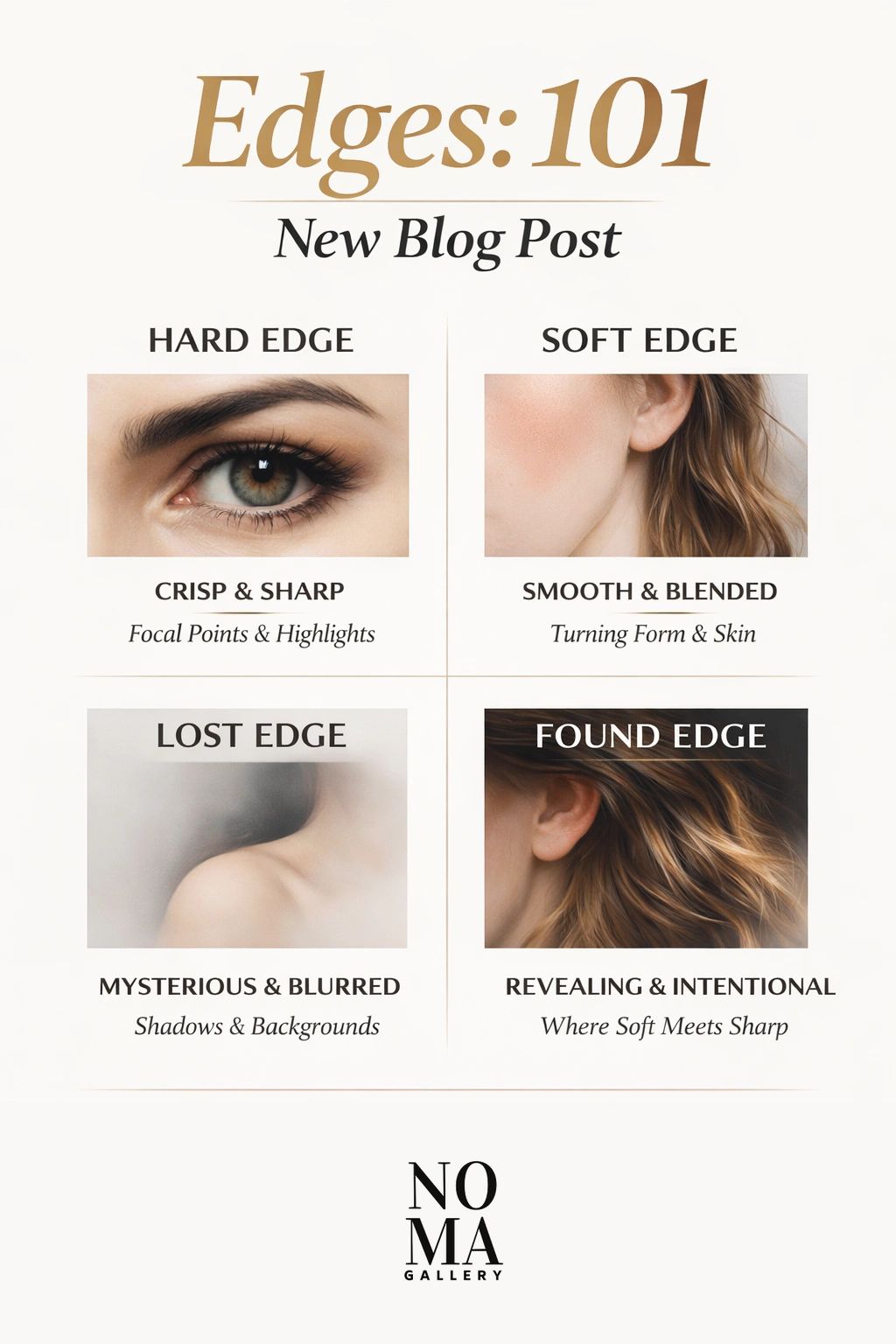
The 4 Edge Types (What You’re Actually Aiming For)
Most people only think “hard” or “soft,” but painters who control edges at a high level think in a range:
1) Hard Edge
A crisp, decisive transition.
Feels: sharp, clear, close, attention-grabbing.
Use it for: focal points, cast shadow accents, places where two planes snap apart.
2) Soft Edge
A gentle transition with a visible but smooth shift.
Feels: rounded, calm, natural, dimensional.
Use it for: turning form, subtle light falloff, skin, cheeks, soft fabrics.
3) Lost Edge
The edge nearly disappears because values merge.
Feels: atmospheric, luminous, “painterly,” realistic.
Use it for: form turning into shadow, hair masses, background merges, soft light scenes.
4) Found Edge
An edge that reappears after being lost—like a whisper becoming clear again.
Feels: intelligent, intentional, cinematic.
Use it for: guiding the viewer through the painting without outlining everything.
Where the Masters Put Hard Edges (and Why)
Here’s the big rule:
Masters place the hardest edges near the focal point—then they ration sharpness everywhere else.
Hard edges act like visual exclamation points. Too many, and your painting starts shouting.
Common “Master Placements” for Hard Edges:
- The eye area (upper eyelid, lash line, tear duct, catchlight edge)
- The mouth accent (a single crisp corner or highlight—not the whole lip outlined)
- Key silhouette moments (one sharp profile edge where the head meets the background)
- Cast shadow accents (under the nose, under the lower lip, jaw shadow edge—sparingly)
- Specular highlights (small, sharp notes on metal, wetness, glossy surfaces)
The key is contrast + restraint.
Hard edges work best when they’re surrounded by softer ones.
Where the Masters Keep Edges Softer (the “Realism” Zones)
Soft edges are what make form feel round and light feel natural.
Best Places for Soft Edges:
- Cheeks, forehead turns, jaw turns
- Rounded limbs (biceps, thighs, shoulders)
- Soft fabric folds
- Hair masses (big shapes first—avoid single-hair outlines)
- Shadow transitions (especially in skin)
A common beginner move is sharpening everything because it feels like “finishing.” But realism comes from selective clarity, not uniform detail.
Lost Edges: the Master Trick That Creates Atmosphere
Lost edges are where paintings start feeling like light and air—not cut-out shapes.
Lost edges happen when:
- the values are close,
- the colors are close,
- the brushwork blends the boundary,
- or the edge is softened by atmosphere or light.
Powerful Places to Lose Edges:
- The shadow side of a face merging into a darker background
- Hair melting into shadow
- Shoulders dissolving into the environment
- Clothing edges in low-contrast light
- Background shapes that shouldn’t compete with your subject
Lost edges create mystery and depth—and they help your focal point pop without over-detail.
The #1 Edge Mistake I See: Outlining
Outlining is usually an attempt to “separate” shapes.
But the masters separate forms with:
- value control
- temperature shifts
- edge variety
- shape design
Not with dark lines around everything.
If you outline every feature, you flatten the form. You turn a living subject into a sticker.
The “Edge Hierarchy” Mindset (Paint Like a Master)
Try this simple hierarchy:
- Focal point = sharpest edges
- Everything else = softer, quieter, simpler
- Deep shadows + background = allow lost edges
- Reserve crisp edges for only a few moments
Think of it like composition:
Edges are compositional tools, not just rendering tools.
How to Control Edges (Practical Techniques You Can Use Today)
1) Paint Wet-Into-Wet for Soft Edges
Lay in your two shapes while both are wet, then gently blend only the boundary.
2) Use the “Two-Brush” Method
One brush lays the edge, a clean/dry brush softens it slightly.
3) Soften by Value Matching (Not Blending)
If the two values are too far apart, you’ll never get a convincing soft edge. Sometimes you need to adjust the value relationship, not just smudge paint.
4) Sharp Edges = Confident Strokes
Hard edges often come from decisive brushwork, not tiny detail brushes.
5) “Lose It, Then Find It”
Intentionally soften an edge for several inches, then bring it back in one spot. That “found edge” will feel unbelievably intentional.
A Simple Edge Exercise (10 Minutes)
Grab any portrait reference.
- Put a timer for 10 minutes.
- Paint/block in only the head and shadow shapes.
- Allow yourself only 3 hard edges total.
- Everything else must be soft or lost.
Your painting will instantly look more unified—and your focal point will naturally emerge.
The Final Rule I Teach (the One That Fixes Paintings Fast)
Edges are a form of respect.
Respect for light. Respect for the viewer. Respect for what matters most.
If human hands once reached that level of mastery, then it’s still worth aiming for. Excellence isn’t arrogance — it’s devotion.
Happy painting!!!